


Introduction
Screw vacuum pumps have become a cornerstone of modern industrial vacuum technology, offering a compelling combination of energy efficiency, reliability, and clean operation. Whether you are in food packaging, semiconductor manufacturing, chemical processing, or automotive production, understanding screw vacuum pump technology is essential for making informed equipment decisions.
This article provides a comprehensive overview of screw vacuum pump working principles, the key differences between oil-injected and oil-free designs, and the factors that matter most when selecting a pump for your application.
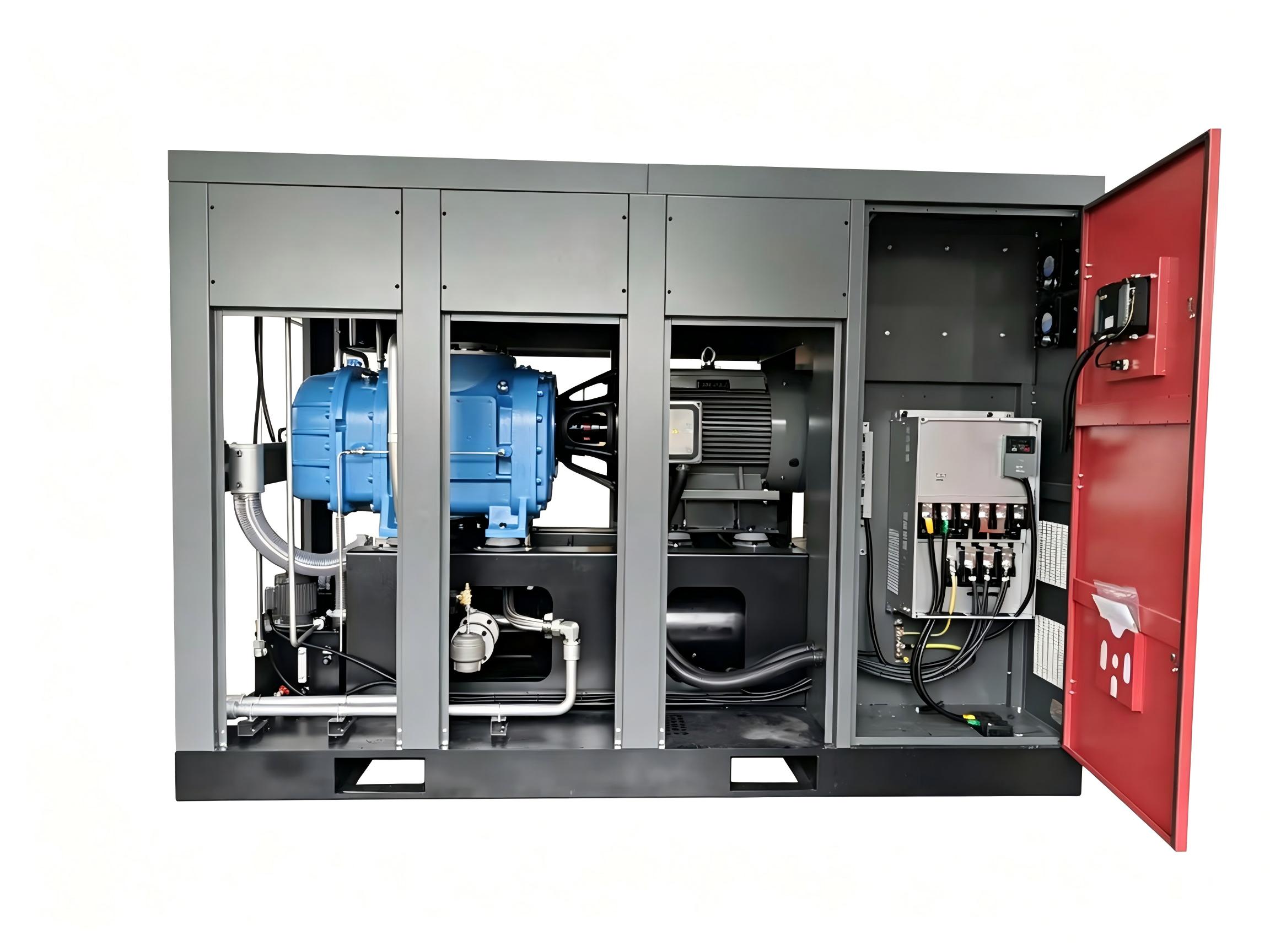
How Screw Vacuum Pumps Work
A screw vacuum pump is a positive displacement pump that uses two parallel, intermeshing screw rotors to trap and compress gas . The rotors—one with a right-hand thread and the other with a left-hand thread—rotate in opposite directions within a cylindrical housing, synchronized by precision timing gears .
The Compression Process
- Gas Intake: As the rotors turn, gas enters through the inlet port and is trapped in chambers formed between the screw threads and the housing wall.
- Axial Transport: The rotation moves the trapped gas along the length of the screws toward the discharge port .
- Compression: The chamber volume progressively decreases as the gas moves toward the outlet, compressing the gas to the required discharge pressure .
- Exhaust: The compressed gas is expelled through the outlet.
In variable pitch models, the screw pitch changes along the rotor length, providing more gradual compression that spreads heat more evenly and improves energy efficiency . In fixed pitch models, most compression occurs near the exhaust end.
Key Design Features
- Contact-Free Operation: The rotors do not touch each other or the housing, eliminating mechanical wear and enabling long service life .
- Tight Clearances: Small gaps between the rotors and the stator minimize backflow leakage, enabling deep vacuum levels down to 0.01 mbar (abs.) .
- External Cooling: Most designs use water-cooled jackets or closed-loop cooling systems to maintain stable operating temperatures .
Oil-Free vs. Oil-Injected Screw Vacuum Pumps
One of the most important decisions when selecting a screw vacuum pump is choosing between oil-free (dry) and oil-injected designs. Each has distinct advantages and trade-offs.
Oil-Free (Dry) Screw Vacuum Pumps
How They Work: No lubrication or sealing fluid is used in the compression chamber. The rotors operate with tight clearances, relying on precision machining rather than fluid seals .
Advantages:
- Contamination-Free Operation: Eliminates the risk of oil carryover, making them ideal for food, pharmaceutical, electronics, and semiconductor applications .
- Lower Maintenance Costs: No oil changes, separator replacements, or oil disposal in the pumping chamber .
- Environmental Compliance: No hazardous waste oil to dispose of .
- Longer Service Intervals: Fewer consumables mean less downtime .
- Suitable for Harsh Gases: Can handle aggressive or corrosive vapors when equipped with appropriate coatings .
Disadvantages:
- Higher initial purchase cost .
- May require purge gas for certain applications .
Total Cost of Ownership (TCO) Perspective: For continuous operation (over 4,000 hours/year), oil-free pumps typically offer lower TCO despite higher upfront costs. A comparative analysis shows that over five years of continuous operation, an oil-free pump can save approximately $44,000 compared to an oil-injected alternative, with payback achieved in about 16 months .
Oil-Injected Screw Vacuum Pumps
How They Work: A small amount of oil is injected into the compression chamber for sealing, cooling, and lubrication .
Advantages:
- Lower initial purchase price .
- Often achieve deeper ultimate vacuum (as low as 0.35 mbar abs.) .
- Higher flow capacities in some designs.
- Suitable for applications where process contamination is less critical.
Disadvantages:
- Ongoing costs for oil, filters, and oil separators .
- Oil disposal and environmental compliance costs .
- Risk of oil carryover and process contamination .
- More maintenance-intensive .
When to Choose: Oil-injected pumps are often the economical choice for operations under 2,000 hours per year where contamination risk is minimal .
Energy Efficiency and Variable Speed Drive (VSD)
Energy consumption is typically the largest component of a vacuum pump’s lifecycle cost. Modern screw vacuum pumps address this through intelligent control and Variable Speed Drive (VSD) technology.
How VSD Delivers Savings
VSD technology automatically adjusts the motor speed to match real-time vacuum demand . Instead of running at full speed and cycling on/off or using throttling valves, the pump operates at the minimum speed needed to maintain the required vacuum level .
Energy Savings: VSD-equipped screw vacuum pumps can achieve energy savings of up to 50% compared to fixed-speed alternatives . This is particularly valuable in applications with variable process loads .
Additional Benefits:
- Reduced wear on moving components .
- Extended maintenance intervals .
- Lower peak power demand, eliminating inrush current spikes.
Efficiency by Technology
| Pump Type | Efficiency Features | Typical Savings |
|---|---|---|
| Oil-free screw with VSD | Patented asymmetrical rotors, IE4 motors | Up to 50% |
| Oil-injected screw with VSD | Adaptive speed control | 35-50% |
Applications Across Industries
Screw vacuum pumps serve a remarkably broad range of industries :
Chemical and Pharmaceutical
- Distillation, drying, evaporation, degassing
- Solvent recovery
- Freeze-drying processes
Electronics and Semiconductors
- CVD/PVD processes
- Wafer handling
- Cleanroom vacuum systems
Food and Beverage
- Packaging and processing
- Freeze-drying
General Industrial
- Central vacuum systems
- Coating, drying, cleaning
- Dust extraction
Automotive and Transportation
- Brake system testing
- Composite manufacturing
Post time: Sep-07-2026